


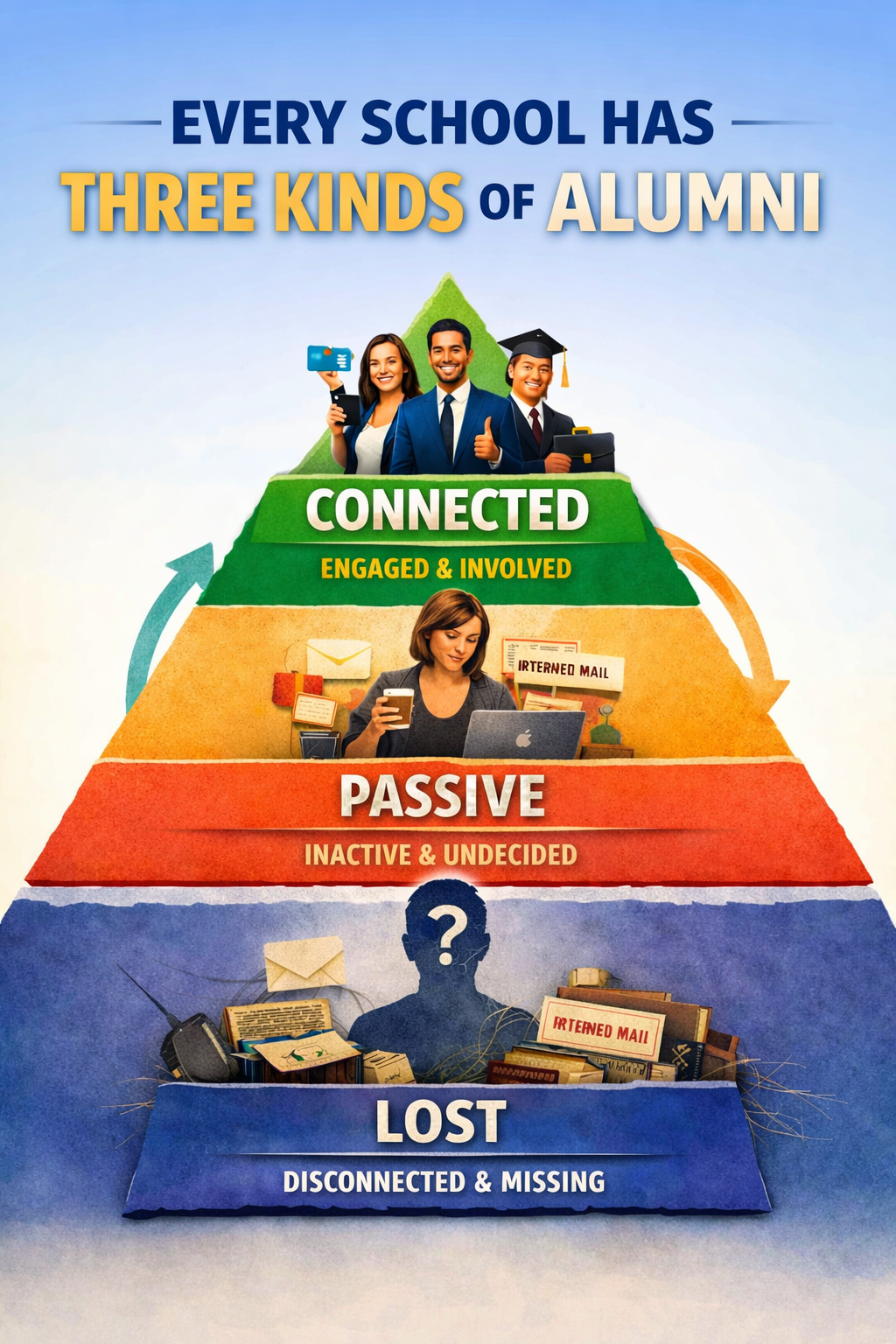
Most schools think they have one alumni list. They actually have three — and each one needs a completely different approach.
After working with hundreds of schools, a pattern keeps repeating. A school will say "we have 10,000 alumni" — but that single number hides three very different realities. Sorting your alumni into these three groups changes what you do next, and where you focus your energy.
1. The connected
These are the alumni you've added who have confirmed and joined your community. Every time you post an update or send a community-highlight snapshot, they see it. This group is your living, engaged network — and once it's moving, it largely sustains itself.
2. The reachable, but not yet joined
You have their details, but they haven't come in yet — maybe a bounced email, an old address, or they simply haven't got around to it. They're not lost. You can still reach them directly, and the goal is simply to convert them into the first group over time.
3. The lost to the network
These are the alumni you currently have no way to reach. For most schools, this is the biggest group — and the one they assume is gone for good. It isn't. Through social-media awareness, peer networks and word of mouth, these alumni can discover your community and find their way back.
The maths that reframes the goal
Picture a school with 10,000 alumni across its history. It might hold records for 6,000 of them, of whom 5,000 have joined the community. That feels like a win — and it is. But the framework reframes what's left to do:

A note on the numbers
This is an illustrative example, not a typical result — every school's numbers are different. The point isn't the figures; it's the three buckets.
Why this matters
Most schools celebrate the 5,000 who joined and stop there. But the real opportunity is in the other half — the 5,000 who are reachable or findable, and who only become visible once you stop treating alumni as a single, undifferentiated list.
So here's a question worth asking at your school: of your three groups, which one are you actually spending your energy on?
alumnly · Alumni engagement software, built for schools