


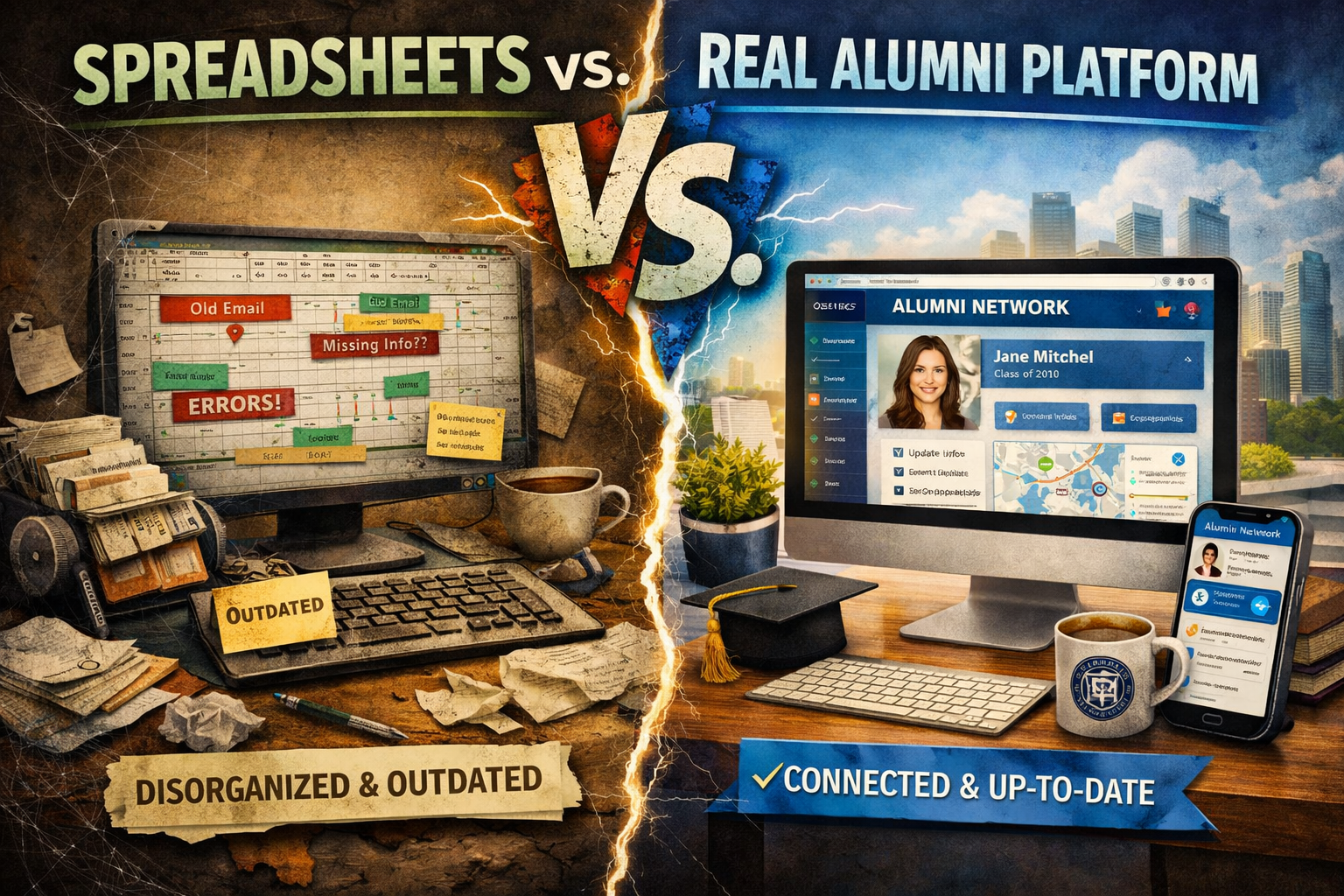
A spreadsheet isn't a bad way to start an alumni list. It's how most schools begin, and there's no shame in it. Here's where it actually starts costing you — in plain terms, without the sales pitch.
We talk to a lot of schools that are running their alumni community out of an Excel sheet. Some of them apologise for it. They shouldn't. A spreadsheet is free, it's flexible, everyone on staff already knows how to use one, and for the first hundred or so contacts it does the job. If you're at the start of an alumni program and you need to get going, a spreadsheet is the honest answer.
But spreadsheets have a quiet limit. Past that limit they don't fail loudly — they just become slow, frustrating and increasingly unreliable in ways that show up months later as a thin reunion or a fundraising appeal that lands in a thousand dead inboxes.
This is an honest accounting of where that limit sits, and what changes on the other side.
What a spreadsheet does well
For up to a few hundred records, a spreadsheet does five things genuinely well. It holds names, addresses, year groups and notes in one place. It's searchable. It can be shared with the people who need it. It backs up easily. And it gives whoever maintains it a sense of what's in the list, because they've touched every row at least once.
If your school is at the early stage of building alumni records — fewer than 500 names, one staff member doing the work — a spreadsheet is fine. Don't let anyone shame you out of it.
Where it stops working
The trouble starts at roughly the point you have something worth doing with the list. Five common breakdowns, in roughly the order schools hit them:
1. Alumni can't find each other.
A spreadsheet lives on a staff member's computer. The people in it have no way to see, search or contact anyone else in it. The list exists; the community doesn't.
2. Nobody can update their own record.
Every change — new email, new surname, new city — has to go through a staff member. Most alumni won't bother. The data goes stale at the speed of the school's manual labour.
3. You can't send anything at scale.
Mail merges into Outlook work for a while, then bounce rates climb and deliverability collapses. By the time a school is mailing 2,000 alumni about a reunion, half the emails are going to spam folders.
4. You can't see what's working.
A spreadsheet doesn't tell you which alumni opened your last newsletter, who clicked, who's been quietly engaging for years, or who hasn't been touched in eighteen months. You're flying without instruments.
5. It doesn't survive staff turnover.
When the person who built the spreadsheet leaves, the institutional knowledge baked into its columns leaves with them. The next person inherits a file they're afraid to change.
The maths of the switch
The honest question isn't is a platform better than a spreadsheet — of course it is. The honest question is: when is the switch worth the change cost?
A rough rule we've watched hold up across hundreds of schools. Once any two of these three are true, the spreadsheet is costing more than it's saving:

The hidden line item
The cost of staying on the spreadsheet usually isn't visible — it's the reunions that didn't fill, the donor that didn't get a thank you, the past student who never knew about the scholarship her year group set up. Lost opportunity is the most expensive line item in a school's alumni program, and it never shows up on an invoice.
When a platform actually earns its place
A platform earns its place when it does three things the spreadsheet can't.
It lets the community talk to itself, without going through you. It maintains its own data, because alumni update their own profiles when they have a reason to come back. And it surfaces who's engaging — so the work you put in lands on the people most likely to respond.
If you're not ready for those three things yet, stay on the spreadsheet. It's a perfectly good place to start, and switching too early is almost as expensive as switching too late.
But if you've outgrown it — if you can feel the friction of the list working against the work — that's the signal. Not a sales pitch. A maths problem.
alumnly · Alumni engagement software, built for schools